Want to replicate an app you love, or rebuild a design you saw, without copying a single line of its code? That is exactly what the free Replica skill for Claude does.
It is a pack of 11 Claude skills that study an app, plan your version, rebuild it screen by screen, test it and help you launch it under your own brand.
I read the whole repository for this guide: the README, all 11 SKILL.md files, the Python tools and the licence. Below you get what it really does, how to install it, a full walkthrough, the honest limits, and what to use instead if you actually wanted to turn an image into a 3D model.
- What: Replica (github.com/Jakeschincariol/replica-skill) is 11 free Claude skills that replicate the features, flows and design system of any app, clean-room style.
- Licence: MIT. No signup, no API key, nothing to connect. Version 1.0.0, about 10.8K GitHub stars when I checked.
- Install:
/plugin marketplace add Jakeschincariol/replica-skillthen/plugin install replica-skill@replica-skillin Claude Code. - Flow: recon, architect, design, build, backend, test, diff, entrepreneur, brand, launch, deploy. Each skill reads the files the last one wrote in a
replica/folder. - Tools: six standard-library Python scripts (layout diff, parity score, review ranking, contrast check, rebrand sweep, store listing lint). Python 3.8+, nothing to pip install.
- Not for: image to 3D, copying source code, logos or content. It rebuilds what an app does, never what it owns.
New to skills? Start with our Claude Skills guide (SKILL.md, uploads and Claude Code), then come back here.
What Is the Replica Skill?
Replica is an open-source skill pack made by Jake Schincariol (opusjake.ai). The README sums it up as “Eleven Claude skills that clone any app.” It ships as plain folders, each with a SKILL.md file, plus a Claude Code plugin manifest.
One skill reverse-engineers the app you want to replicate. Others plan the stack, rebuild the design system, write the code, test it, score how close you got, and finally rebrand and ship it on your own domain.
The twist is the Entrepreneur skill. It reads what real users hate about the original app in public reviews, then turns those complaints into fixes for your version. The idea is that a straight copy has no reason to exist, but a better version can sell.
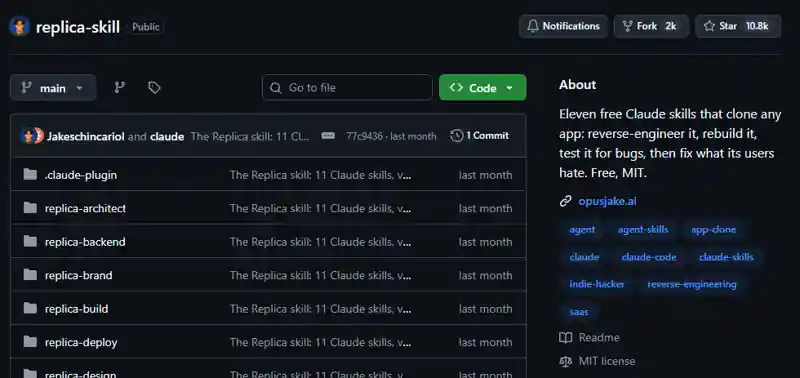
| Fact | Detail (from the repo) |
|---|---|
| Author | Jake Schincariol (opusjake.ai) |
| Licence | MIT, copyright 2026 |
| Version | 1.0.0 in .claude-plugin/plugin.json |
| First commit | 3 October 2026 (one commit at the time of writing) |
| Skills | 11, all named replica-* |
| Tools | 6 standard-library Python scripts, none touch the network |
| Needs | Claude (Claude Code for the full pack), Python 3.8+ for the tools |
| Cost | Free. You pay only for your own Claude plan and any services you deploy on |
What Can It Replicate (and What Not)?
This is the most important section, so here it is plainly. Replica replicates functionality and UX patterns. It studies what an app does and how people move through it, then writes everything fresh.
| Replica will rebuild | Replica will not take |
|---|---|
| Screens, user flows and every state (empty, loading, error, mobile) | The original’s source code, JavaScript bundles or private APIs |
| The design system: colour roles, type scale, spacing, components | Logos, icons, illustrations, photos, sounds or licensed fonts |
| An inferred data model, database schema and API | Their copy, labels and marketing text |
| Auth, payments, email and integrations via official APIs | Content, catalogues, networks or data the app owns |
| A feature parity score and layout comparison | Anything behind someone else’s login or a paywall |
The README puts it in one line: “It rebuilds what an app does, never what it owns.” The skills enforce it too. For example, /replica-deploy refuses to ship until the rebrand sweep finds nothing of the original left.
The 11 Skills Explained
Each skill is a slash command. Here is what every one does, based on its own SKILL.md.
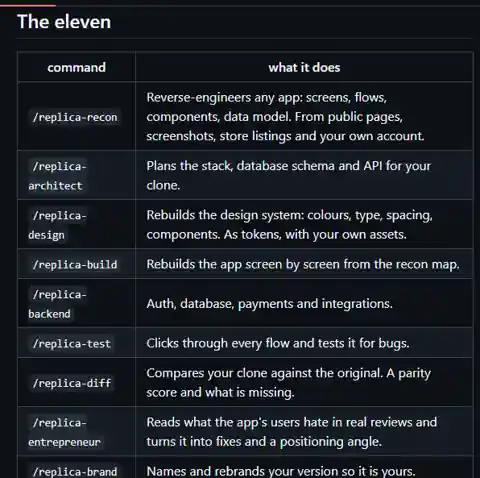
| Command | What it does | Main output |
|---|---|---|
/replica-recon |
Reverse-engineers the app from public pages, help docs, store listings, walkthrough videos and your own account | replica/recon.md, features.csv |
/replica-architect |
Picks a stack (default Next.js, Postgres, Stripe, Resend), writes SQL schema and API routes, orders the build | replica/architecture.md |
/replica-design |
Measures screenshots into design tokens and component specs, with open icons and fonts | replica/design/tokens.json |
/replica-build |
Builds the shell, then the core flow end to end, then every screen with all its states | Your app code, build-log.md |
/replica-backend |
Auth, migrations, access rules, Stripe, email, jobs and official integrations | replica/backend.md |
/replica-test |
Writes a test plan from the flows, Playwright specs and bug reports by severity | test-plan.md, bugs.md |
/replica-diff |
Scores feature parity and compares screen layouts, ignoring colour | replica/parity.md |
/replica-entrepreneur |
Ranks what real reviewers hate, with linked verbatim quotes, and writes a fix plan and angle | feedback.md, fixes.md |
/replica-brand |
Names and rebrands your version, lists trademark and domain checks, sweeps leftovers | brand.md, brand.json |
/replica-launch |
Landing page, pricing and App Store / Play listing, linted against store rules | replica/launch/ |
/replica-deploy |
Preflight gate, production setup, DNS records, Stripe live mode, then ships on your go | replica/deploy.md |
How to Install Replica
You have four ways to install it. Pick the one that matches how you use Claude.
Option 1: As a Claude Code plugin (easiest)
- Open Claude Code in your project folder.
- Run
/plugin marketplace add Jakeschincariol/replica-skill - Run
/plugin install replica-skill@replica-skill - The skills appear namespaced, for example
/replica-skill:replica-recon.
Option 2: Copy the folders (plain command names)
If you prefer short names like /replica-recon, copy the folders into your personal skills folder:
git clone https://github.com/Jakeschincariol/replica-skill.git
cp -r replica-skill/replica-* ~/.claude/skills/
For one project only, copy the same folders into that repo’s .claude/skills/ folder instead.
Option 3: Paste the link into Claude
The README also suggests pasting the GitHub link followed by the words “install skill” into Claude and letting it handle the setup.
Option 4: No Claude Code at all
Paste any single SKILL.md at the top of a normal Claude chat and it runs as a mode. You lose the Python tools, but the method still works.
cp command in Git Bash or WSL, or just copy the 11 replica-* folders into %USERPROFILE%\.claude\skills with File Explorer.Step by Step: Replicate an App With Claude
The skills are meant to run in order. Each one reads what the previous one wrote in the replica/ folder of your project. The README’s own example is a scheduling app, the kind where people book a time with you.
- Recon. Run
/replica-reconwith the app’s URL. It asks which app, which platform and which slice (for example, “the booking flow”, not “all of it”). It then builds a sources table, a screen inventory with IDs (S01, S02…), user flows (F01, F02…), components, an inferred data model with confidence levels, and a feature matrix rated must, should or could. It ends with an honest size: S (a weekend), M (a few weeks), L (a quarter) or XL (rescope it). - Architect.
/replica-architectturns the data model into real SQL, with owner columns, indexes, UTC timestamps, money as integer cents and access rules. It orders the build as a thin vertical slice first. - Design.
/replica-designmeasures your reference screenshots into colour roles, a type scale, spacing, radius and component specs. Logos, icons and paid fonts are swapped for open ones such as Lucide icons and Inter. - Build.
/replica-buildwrites every line fresh. Shell first, then the core loop end to end, then each screen with every state, ticking offfeatures.csvas it goes. - Backend.
/replica-backendadds sign up, the database, Stripe Checkout and webhooks, and emails. You create the accounts and keys yourself; Claude only writes.env.examplewith the variable names. - Test.
/replica-testwrites happy paths, edge cases (double submit, time zones, offline, a second user’s data) and negative cases, then Playwright specs. Bugs are logged until no S1 or S2 is open. - Diff.
/replica-diffgives you a real parity number and the missing list in build order. - Entrepreneur.
/replica-entrepreneurcollects 100+ public reviews from at least three sources and ranks the complaints with counts and linked quotes. - Brand.
/replica-brandgenerates 20 name ideas, cuts them to 5, lists the trademark and domain checks to run, and builds a new palette. - Launch.
/replica-launchwrites the landing page around your angle, sets pricing and lints the store listing. - Deploy.
/replica-deployruns the preflight (tests, parity, sweep, listing, build) and ships only when you say go.
You can also run any one skill on its own. The README suggests running /replica-entrepreneur on an app you are only thinking about cloning, to find out if it is worth it.
How to Replicate a Design or Website Look
A lot of people search for ways to “replicate any design” with AI. With Replica, that job belongs to /replica-recon plus /replica-design, and it works at the level of a design system, not a pixel copy.
- Save reference screenshots of the screens you like into
replica/screens/, from public pages or your own account. - Run
/replica-design. It records colour roles (bg, surface, text, accent and so on), counts the real greys (usually 5 to 7), snaps sizes to a type scale such as 12, 14, 16, 20, 28, 40, and finds the spacing base (almost always 4 or 8). - It writes
tokens.json,tokens.css, a Tailwind mapping andcomponents.mdwith every component and its states. - Check readability with
python3 contrast.py replica/design/tokens.json, which prints the WCAG contrast ratio for every text pair. - Later,
/replica-brandswaps in your own palette, keeping the same token roles.
The Six Python Tools
All six use only the Python standard library and none touch the network. Paths below assume you are inside the cloned repo; under ~/.claude/skills/ prefix them accordingly.
| Tool | Command | What it checks |
|---|---|---|
imgdiff.py |
python3 replica-diff/imgdiff.py original.png clone.png --out diff.png |
Layout difference using edge maps, so new colours do not count against you. Scores matches 90+, close 75+, partly 50+ |
parity.py |
python3 replica-diff/parity.py replica/features.csv |
Feature parity: must 3, should 2, could 1, partial counts half, skipped rows excluded |
reviews.py |
python3 replica-entrepreneur/reviews.py replica/reviews.csv |
Ranks complaint themes, drops any review without a link, marks thin themes |
contrast.py |
python3 replica-design/contrast.py replica/design/tokens.json |
WCAG contrast for every text pair in your tokens |
sweep.py |
python3 replica-brand/sweep.py . --avoid "Original App" |
Finds the original’s name, domain or colours anywhere in your code, even inside identifiers |
listing.py |
python3 replica-launch/listing.py replica/launch/listing.json |
App Store and Google Play limits, ranking claims, wasted keyword characters, the original’s name |
The repo also includes unit tests for every tool, which you can run with python3 -m unittest discover -s tests -v from the repo root.
The parity verdicts are strict. Any missing must-have or open S1 bug means “not shippable”. Shippable needs all must-haves, a feature score of 80+ and no open S1 or S2. The goal the skill names is “better than the original”: shippable plus the Entrepreneur fixes.
Can It Replicate an Image Into 3D?
No. I searched every file in the repo, and Replica has no image-to-3D, mesh or 3D model features. Its screenshots are used only as layout references for app screens, never turned into 3D.
If your real goal is “replicate any image into 3D”, you want an image-to-3D model instead. We have hands-on guides for that:
- ComfyUI Pixal3D + TRELLIS.2 workflow: image to 3D mesh with every model file and folder.
- Idol in ComfyUI: one image to a 3D Gaussian splat on a 10 to 16 GB GPU.
A fun combo: use one of those to make 3D assets of your own, then use Replica to rebuild the app around them. The two solve different problems.
Replica vs Other Ways to Replicate Apps and Designs
| Tool | Best for | How it works | Cost |
|---|---|---|---|
| Replica skill | Rebuilding a whole app’s features, design system and launch, with parity scoring | 11 Claude skills plus Python tools, files in replica/ |
Free (MIT) plus your Claude plan |
| screenshot-to-code (open source) | Turning one screenshot into front-end code quickly | Sends a screenshot to a vision model, returns HTML/React | Free code, you pay the model API |
| Prompt-to-app builders (Lovable, Bolt.new, v0) | Fast prototypes from a text description in the browser | Hosted AI builders with their own editors | Free tiers, paid plans |
| Plain Claude Code with no skill | Small rebuilds where you write the plan yourself | You prompt each step manually | Your Claude plan |
| Image-to-3D models (TRELLIS, Idol) | Replicating an object from a photo as a 3D model | Local ComfyUI workflows on your GPU | Free, needs a GPU |
Where Replica stands out is process. The others give you code; Replica also gives you a recon map, a test plan, a parity number, a review-based fix plan and a rebrand gate.
Limits, Licence and Legal Notes
- No perfect clone. The README is honest: a booking tool is weeks of work, a spreadsheet engine is not realistic. Recon sizes the job before you start.
- Public sources and your own account only. No scraping, no crawling, no logging into other accounts, no getting past paywalls. If your account’s terms ban building a competitor, it says so and sticks to public pages.
- You handle accounts and money. Claude never signs up for services, types passwords, enters cards or buys domains. It writes the exact steps, records and env var names for you.
- No fake proof. No invented reviews, testimonials, user counts or ratings. Reviewer quotes are research only, never landing-page testimonials.
- Not legal advice. The brand skill’s trademark checks are screening only. The README tells you to talk to a lawyer before launch if money is on the line.
- Young project. Version 1.0.0 with a single commit at the time of writing, so expect changes. Check the repo before relying on any detail.
- Licence: MIT. You can use, change, ship and sell your work. Keep the copyright notice if you redistribute the skills themselves.
Troubleshooting
| Problem | Fix |
|---|---|
/replica-recon not found after plugin install |
Plugin skills are namespaced. Type /replica-skill:replica-recon, or copy the folders to ~/.claude/skills/ for plain names. |
| Architect says there is no recon map | By design. Run /replica-recon first so replica/recon.md and features.csv exist. |
python3 not recognised on Windows |
Use python or py instead, and check you have Python 3.8 or newer. |
parity.py cannot find the file |
Run it from your project root, and point to the full skill path, for example ~/.claude/skills/replica-diff/parity.py. |
| Layout diff score looks wrong | Take both screenshots at the same viewport (1440×900 or 390×844) and in the same state. Use --mode pixel only for your own clone vs an older clone. |
| Deploy refuses to ship | Read the preflight output. Usually sweep.py still finds the original’s name or colour, a must-have is missing, or tests fail. |
reviews.py drops most rows |
Every review row needs its source URL. Rows without a link are dropped on purpose. |
| Skill refuses to log in or scrape | Also by design. Log in yourself in your own browser, and use public pages or official feeds such as the Apple reviews RSS. |
My Take
Replica is one of the most thought-through skill packs I have read. It is less a magic “clone any app” button and more a disciplined product process that Claude follows step by step, with guard rails on every stage.
If you are an indie hacker who wants to build a better version of a tool people complain about, start with /replica-entrepreneur and /replica-recon. If they tell you the gap is real and the size is S or M, run the rest.
Just keep your expectations right: it replicates apps and designs, not 3D objects, and not anything the original owns. For more ready-made skills, see our Claude Skills hub and the Claude Clipper skill guide. And if you plan to build games, read why Claude Code won’t recreate existing games first.
FAQ
Is the Replica skill free?
Yes. It is MIT licensed with no signup, API key or connection needed. You only pay for your own Claude plan and for any hosting or services you deploy your app on.
Does Replica copy an app’s code?
No. It is clean-room: it studies features, flows and the design system from public sources and your own account, then writes every line fresh. It never copies source code, logos, copy or private APIs.
Can Replica turn an image into a 3D model?
No. It has no 3D features. For image to 3D, use a model like TRELLIS.2 or Idol in ComfyUI.
Do I need Claude Code to use it?
Claude Code gives you the full pack and the Python tools. Without it, you can paste a single SKILL.md into a Claude chat and it runs as a mode, minus the tools.
Can I replicate just a website design with it?
Yes. Run /replica-recon and /replica-design on your reference screenshots to get design tokens and component specs. You get the system, not a pixel copy, and you add your own brand later.
Is it legal to sell an app built with Replica?
Rebuilding features is generally different from copying protected assets, and the pack forces a full rebrand before deploy. Still, run the trademark checks it lists and talk to a lawyer before launch. This is not legal advice.
How long does it take to replicate an app?
It depends on the app. Recon gives a size from S (a weekend) to XL (rescope it). The README says a booking tool is weeks of work.
What stack does Replica use?
Your own, if you already have one. Otherwise the default is Next.js with TypeScript and Tailwind, Postgres on Supabase or Neon, Stripe, Resend and Vercel, with Expo for mobile.
Sources
- GitHub: github.com/Jakeschincariol/replica-skill (README, 11 SKILL.md files, LICENSE, .claude-plugin/plugin.json and marketplace.json), read 27 November 2026
- replica-recon, replica-design and replica-diff SKILL.md files (recon steps, token rules, parity verdicts)
- Author site: opusjake.ai (linked from the repo)